
MASTER THE DARK ART OF IMPORTING A YACHT.
Updated: Feb 22
HOW TO AVOID THE FEAR, UNCERTAINTY AND DOUBT WHEN BRINGING YOUR YACHT BACK TO AUSTRALIA

You have finished your sailing passage to Australia; avoiding cyclones, battling massive seas, eating poorly, being wet & cold, dealing with a mutinous crew and now with the first sign of civilization you face your greatest challenge – bureaucracy. This will surely test you more than sailing into a storm.
"Sometimes I'm confused by what I think is really obvious. But what I think is really obvious obviously isn't obvious?"
The process of returning your yacht to Australia and going through all of the entry protocols

can be overwhelming at the best of times. It will be very administrative and will involve:
Identifying the relevant port of entry,
Finding the boarding station and making bookings,
Understanding and following harbour protocols,
Interfacing with the Australian Border Force regarding notification schedule and reporting,
Ensuring all your documents are filed and/or are onboard,
Planning your customs process,
Arranging for biosecurity to inspect for food, infestation and wood, and so on...
It would be like earning a university degree to cover off all of the steps involved. So, in this story we’ll focus on the area that causes the most angst - what to do when you are told that you must import your vessel upon return. This sends the blood pressure up for many a hardened skipper.
FEAR, UNCERTAINTY AND DOUBT
There is a lot of bewilderment and frustration among yacht owners who bring their yachts back to Australia from overseas when they are told that they must “import the vessel” by Australian Border Force. Immediately many owners start feeling FUD. In their minds they are being asked to pay taxes on something that they already purchased in Australia - 15% of the yachts value flashes before one’s life – there goes the new set of sails.
Men go to far greater lengths to avoid what they fear than to obtain what they desire.
Fear, uncertainty and doubt, frequently abbreviated as FUD, is a tactic used by some dodgy salespeople. It’s a tool used to influence perception by disseminating negative and dubious or false information – they prey on inexperience.
I am sad to say that there is considerable FUD in the area of importing a yacht which is being perpetuated by people who stand to gain by this FUD. By spreading questionable information about the drawbacks of DIY yacht import skippers can be persuaded to pay a professional when in reality they don’t need to. The trick is knowing when to use a professional when importing a yacht back into Australia.
FUD thrives when the process is hard to visualise. So here’s the filter I use:
If someone can’t explain the import pathway as a clear sequence (who, what, when, and what triggers what), they’re guessing.
Importing isn’t “one form”. It’s a clearance chain with timing gates — and it punishes out-of-order moves.
This story will help you understand the process and hopefully reduce your stress levels. You should be able to work out if you need the services of a professional or if you should DIY.
LEAVING AUSTRALIA THE RIGHT WAY
Let’s start with the basics. When you leave Australia (on your yacht) you need to clear out of Australia. We all understand that formal clearance by ABF is required before you depart, and that it is an offence to depart without getting this clearance. Think of this as a permission slip to leave.
Further your Australian yacht should be listed on the Australian Registrar of Ships operated by AMSA https://www.amsa.gov.au/vessels-operators/ship-registration and you should have title to the yacht. You do this because often you will need to prove that you own the yacht to other authorities.
Declaring what is on the yacht is an extra step that many skippers forget. This is another form which is an export declaration. The important thing to remember when clearing out is to ensure that you list everything of value on the vessel including your crew’s personal electronic items on this declaration. This ensures that you don't get charged GST and duties for bringing these items back into Australia when you return.
Many skippers get caught here. In their rush to depart and not miss the weather window they provide sparse details on equipment on their yacht when making an export declaration. When they eventually do return, they will need to explain the new glistening things onboard that have mysteriously appeared on the yacht while it was away – for example radar, AIS, radios, chart plotters.
DEATH, TAXES & GETTING WET, THERE'S NEVER ANY CONVENIENT TIME FOR ANY OF THEM
In life the three sure things are death, taxes and getting wet when sailing - we dont get to choose when these happen.

Some cunning owners refit their yachts with lots of gadgets while away overseas – their thinking is that they will save on taxes when they come in. The government in its wisdom and to catch these wily operators have a process in place to ensure that the right amount of tax is paid.
By failing to prepare, you are preparing to fail
The best thing to do is to document every item of value on your vessel so that it is on record when you departed Australia. The more meticulous the better. You should have pictures as well that supports the assertions of what was installed on the vessel along with demonstrating the condition. It is highly recommended you keep service records and parts purchase receipts. Some think this is painful, but the pain finding old receipts can be more intense while your vessel is impounded.
I hate paying taxes. But I love the civilization they give me
Aside from people smuggeling and contraband and bio-security - the main thing you need to understand is that ABF is checking that you are not dodging paying duty and GST on items when you come back in on a vessel.
If you sail the yacht to Australia, ABF may treat “international transport” as essential sailing costs (not a random freight number). That typically means costs necessarily incurred while actually sailing the commercially viable route — and it generally excludes in-port stopover spending.
This includes any enhancements or modifications made to the vessel while it was away. Coming back with new rig, new sails, and electronics and not being able to explain these will create a few “expensive” issues for any owner going through an importation.
As a baseline, yachts attract 5% duty (on customs value) and 10% GST, and GST is calculated on the customs value plus international transport/insurance plus duty.
ABF will often accept the transaction value (what you paid) — but expect alternative valuation if the yacht was owner-built, heavily modified, sold between related parties, or the purchase price is too far back in time.
If you sail the yacht into Australia, “freight” isn’t a shipping invoice — ABF may look at essential sailing costs under commercially viable conditions (charts/books, crew costs, food, fuel), and typically not your in-marina stopover lifestyle spend.
UNDERTAKING AN INTERNATIONAL RACE
Doing an international yacht race is exciting and a captivating idea but there are some ‘got-ya’ moments when you participate in an international race.
You cannot escape the responsibility of tomorrow by evading it today
All care but no responsibility. The race organizer usually obtains all the approvals for the entrants and undertakes the administration. This is risky as any innocent mistake that they might make could result in pain to be felt by the owner. You should always obtain a copy of any documentation made on your behalf. It is worth reading the following link from AMSA on international yacht races and ensure that your race organizer is following this.
If your yacht is unregistered and you’re doing an international race/rally, AMSA can issue a temporary pass — and you generally need one for the outgoing voyage and another for the return.
It was a good idea at the time. If you undertake a international race, finish at a port (outside of Australian waters) and decide to then visit other places, by yacht, you will most likely automatically fall into the ‘re-import the vessel’ category when you come back. Many unsuspecting skippers don't realize what they have just done. They step from one world into another with this innocent move.
WHEN YOU COME BACK
Owners become extremely frustrated when they come back to learn that they have to now re-import the vessel back into Australia.
In the case where you intend to stay on at the destination for an extended period or choose to cruise for an extended period then as the owner you should arrange individually to complete the exportation document.
Most races have an exemption made for yachts to undertake the race and then come back. The nature of this exemption is discretionary by ABF. The vessel is logged in their systems as being in the race so when it returns all should be good.
This extract from the ABF should help clarify things for you.
Export declarations are required for small craft departing Australia. All small craft departing Australia for a place overseas are considered exported and require an export declaration to be lodged. This is also the case for Australian-owned vessels. When an Australian-owned and registered vessel returns to Australia and has ceased its international voyage the vessel may be imported on a formal import declaration quoting GST exemption code 417 (GSTE417) for returned Australian goods. There are circumstances where an export declaration may not be required, such as for a foreign owned yacht with a control permit departing Australia for a place overseas; or when an Australian owned yacht departs Australia to participate in a race and returns to Australia without visiting multiple ports overseas.
Taxation is a serious enterprise. 500 years ago they cut your head off. Today its only "frustration by paperwork" which sounds like an improvement, I think.
The ABF have significant powers to deem a vessel as being imported. This power comes from legislation http://www5.austlii.edu.au/au/legis/cth/consol_act/ca1901124/s49a.html.
A useful way to think about it is that once you are classified as importing a vessel the onus is on you to prove why you shouldn't pay duty and tax on the vessel – this is a procedural way of ensuring that anyone entering by vessel into Australia is assessed in a consistent way. Consistent way means you need a bureaucracy.
Unfortunately for yachties this means that the vessel is treated like a “good” in this situation the goods are the yacht, its fittings and fixtures.
The ABF systems are mainly geared for the management of goods in traditional form i.e. Containers full of car parts, bulk goods carriers, car carriers and so on. Importation of yachts is a very insignificant part of Australia’s trade. The importance of yachts compared to containers being imported is self-evident. This explains why the system treats a yacht coming back like a “good”.
The good news is if you have done all your paperwork in the right way when clearing out the effort of “importing a vessel” will be easy, simplified or maybe even avoided.
However, if you have been deemed to be importing a vessel you will have to go through the formalities, just like you are bringing in a container of TVs. Think of this process as something to ensure that no-one is bypassing paying duties and taxes on their way into Australia. You’re doing your bit for the country.
COMING IN VIA THRUSDAY ISLAND
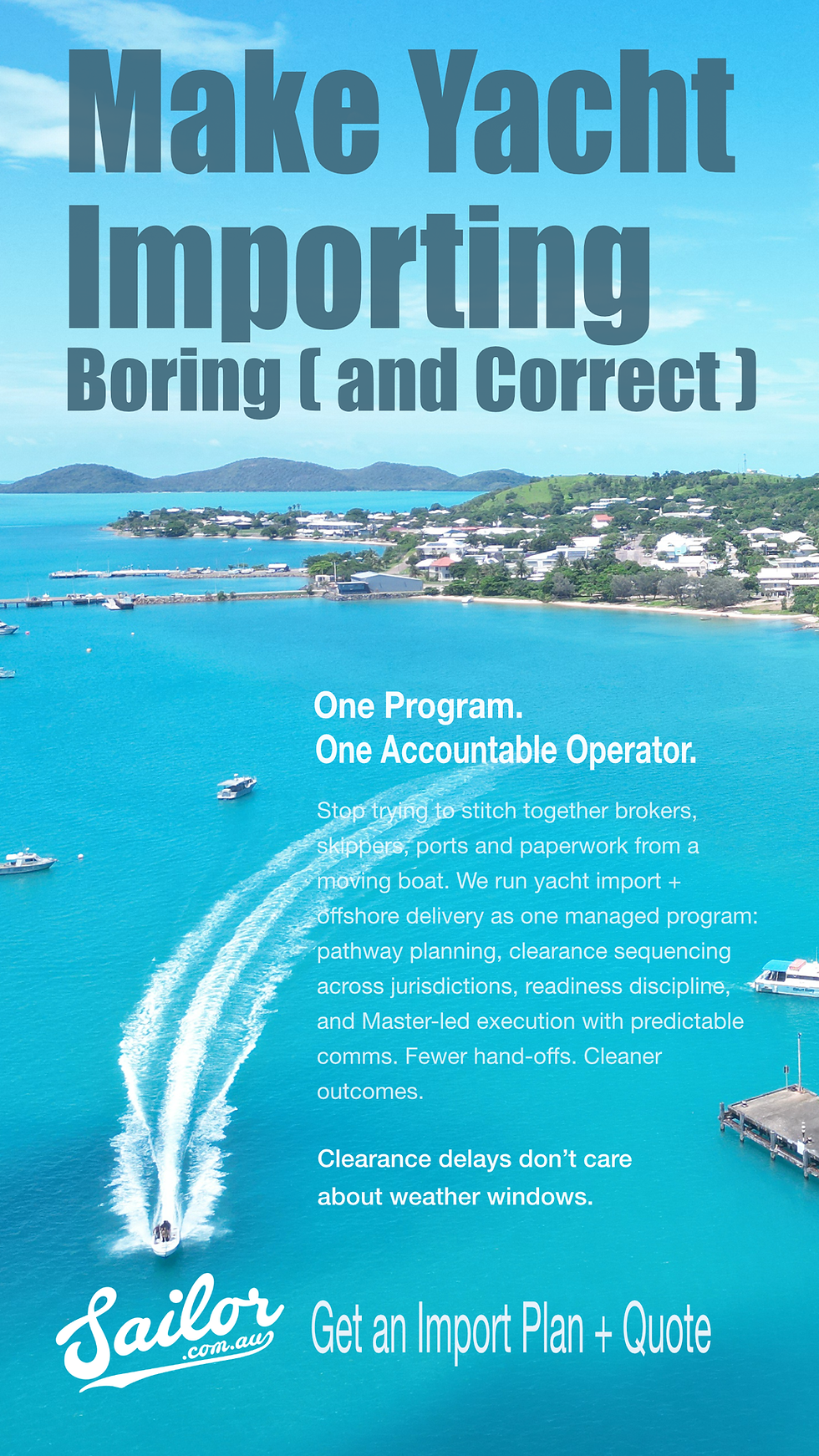
Entering via Thursday Island / Horn Island (Port Kennedy) is where the “dark art” becomes real, fast. It’s a designated First Point of Entry, which means you don’t just roll in like a casual tourist with a sunburn and a story — you arrive into a clearance machine. The big gate is the Pre-Arrival Report (PAR): for non-commercial vessels it must be lodged via the government PAR web portal no earlier than 90 days and no later than 12 hours before you enter Australian territory. This is not optional admin theatre — it’s the first domino in a sequence that triggers risk assessment and inspection planning. Then there’s the practical side that catches people out: TI is often an anchorage-and-wait arrival, with strong tidal flows and exposure that can make “where do we sit?” a real decision, not a nice-to-have. You’re expected to proceed to the nominated entry area, run the flags/protocols, and be ready for a proper biosecurity interaction — think food, waste, and anything biological that looks like it has ambitions of living in Australia. This is exactly why we plan the import pathway against real ports and real conditions, not against a neat checklist. If you want the sailor-to-sailor version of how these ports behave in real life — anchorage preferences, local quirks, who actually turns up, and what tends to surprise cruisers — Noonsite.com is one of the better “field guides”. It’s not a substitute for government requirements (it can’t be), but it’s excellent for the practical layer: what Thursday Island feels like as a first point of entry, and how clearance tends to play out on the water. I use it as a reality check when planning arrivals, alongside the official PAR and port determinations.
The “Make Biosecurity Boring” Checklist (Non-Commercial Yacht Arrival)
A) Before you enter Australian waters (do this early)
Read the DAFF non-commercial vessel rules once and brief everyone onboard (yes, even the confident one).
Lodge your PAR (Pre-Arrival Report) online — you can submit it up to 90 days out, but no later than 12 hours before you enter Australian territory.
In the PAR, be ready to answer (and have evidence for):
Where the yacht has been (travel history) and timber components/refits
Any animals onboard (including pets) and any “hitchhiker” pests you’ve seen
Waste management (best move: remove as much as you can before Australia)
Biofouling management (what you’ve done, when, and where)
If anyone onboard is unwell (or worse), be prepared to report human health issues on arrival.
Food strategy (the easy win):
Don’t load up on fresh produce at the last foreign port.
Double-bag any leftover “organic provisions” (fresh fruit/veg/meat etc.) so it’s ready to hand over as biosecurity waste.
B) When you’re approaching Australia (entry planning)
Watch for the email directions you receive after PAR submission (Biosecurity Status Documents / BSDs) and follow them — if instructions change, it’s usually because your risk profile changed.
Arrive at a First Point of Entry (FPOE) or get permission to arrive somewhere else at least 10 days before arrival.
Fly the correct quarantine signal until pratique is granted:
“QQ” flags, or at night red over white lights.
Make the boat “inspection-ready”: panels off, lockers accessible, cupboards opened — especially anywhere with timber surfaces.
C) At mooring (what happens on the day)
Expect inspections only in safe conditions, daylight, and typically normal operational hours at the approved entry point.
Provide safe access to the vessel (don’t make the officer do acrobatics).
No one gets on or off (no embarking/disembarking) until pratique is assessed and granted.
Declare everything that could be a risk:
food/provisions, plant material, animal products, animals/pets
any insects/rodents/birds/“hitchhikers”
Have all fresh fruit/veg/meat/eggs and waste secured + double-bagged for removal.
If you have pets/animals onboard, tell the officer immediately and confine them. No permit = risk of being treated as illegally imported.
Be ready for:
fees/levies payable at inspection
more than one inspection if risks are found
waste fees charged by the marina/operator, and sometimes extra supervised disposal fees
D) The rule that catches people out
If your ETA, crew health, or onboard situation changes: report it ASAP. Don’t “wait and see”.

IMPORTING THE VESSEL
When being asked to “import the vessel” if you can afford a customs broker this is usually fastest and easiest way to undertake an import. The trick to a good result here is finding a broker that is decent at what they do and understands what is needed to be done when importing a vessel. Some brokers have never done a vessel import – and may be learning on the job at your expense. We often use decent brokers when we need to deal with importing a vessel - it is a fairly straight forward thing and quick.
Government departments really aren’t set up to deal with individuals, their systems are not designed to process all the paperwork, hence why electronic lodgements are the preferred method. To go through a manual clearance process may take anywhere from 3 weeks to 2 months.
To contrast the manual process we spoke with a well known Australian broker Dazmac - they can have a yacht pre-cleared and finalised once Quarantine has done their part in 2-3 days after arrival. Dazmac provide a good guide that outlines how their process works that owners will find useful. (see https://www.dazmac.com.au/sailing-into-australia.html ).
DIY FORM FILLING
Now the notion of paying someone to do this paperwork makes your blood boil – the good news is that you can do it yourself. Just don't get it wrong.
From 27 February 2026, biosecurity reports under the regulations are required to be given electronically (not “whatever method worked last year”). Translation: assume online-first reporting and build it into your plan early. For non-commercial vessels, biosecurity wants your Pre‑Arrival Report submitted up to 90 days before arrival, and no later than 12 hours before entering Australian territory. Do it early, then update it as your ETA tightens.
The Do-It-Yourself vessel (re)import can also be done. The key steps here are to: -
Complete and submit the “Import declaration (N10) form” found on https://www.abf.gov.au/form-listing/forms/b650.pdf
A guide for filling this form can be found at https://www.abf.gov.au/help-and-support-subsite/Guides/doc-import-declaration-guide.pdf
Complete and submit a Cargo Online Lodgement VIA https://online.agriculture.gov.au/cols with DAWE (Department of Agriculture, Water and the Environment - formally AQIS). This needs to be lodged after the Health Pratique / Timber Inspection and once Cutoms have process the B650 (N10 from) and provided an Entry number for the import (formal import declaration FID)

Also, you will need to gather documentation that supports
your ownership
proof of purchase
electronic equipment on board
A chronology of what you did after leaving Australia supported by AIS or other documentation
Clearance documentation of the last port before entry into Australia
You will require Gas Exemption Documents. You will also need to deal with refrigerant gases – make sure you research what gases your vessel has. This allows you to make use of a personal import exemption for your onboard gases (in refrigeration equipment / air conditioning)
You may need to find yourself a Yacht Surveyor to value the vessel if there is a dispute as to the value of the yacht
A pratique inspection slip. If a timber inspection has not been undertaken on the yacht - it may have to be done depending on the materials used on the vessel. See https://www.agriculture.gov.au/biosecurity/avm/vessels/human_health/vessel-pratique for more about pratique. It is worthwhile learning more about biosecurity https://www.agriculture.gov.au/biosecurity/avm/vessels/non-commercial-vessels

Remember to compete the pre-arrival report (PAR) at the portal select
"Launch the non-commercial vessel PAR registration web portal" on this https://www.agriculture.gov.au/biosecurity-trade/aircraft-vessels-military/vessels/non-commercial-vessels
It is worth knowing that if you purchased the yacht in Australia, go overseas and come back that you are exempted under By-law Number 0176871 Item 17 – Goods exported and returned to Australia in an unaltered condition.
(See https://www.abf.gov.au/tariff-classification-subsite/files/Guides/guidelines-schedule-4.pdf page 42. )
Even if you purchased the yacht overseas all is not lost since Australia holds many trade agreements and knowledge of these can be used to minimize or eliminate duties and taxes – for example with the USA. Import tax (GST) is still payable on the purchase price + sailing costs
Customs has a mechanism where a vessel can be deemed imported if it remains in Australia for a period after a notice is served — the legislation spells out a 30-day period from service of notice, with extensions possible (e.g. weather).
DEALING WITH THE BUREAUCRACY
Many owners lose their cool when importing a yacht but most are fine with it. Here are some suggestions to help you navigate those waters.
Here’s the cheat-code: you’re managing four parallel lanes, each with timing windows:
Home Affairs / ABF (arrival reporting + customs)
Biosecurity (DAFF reporting + inspections)
Human health / Pratique (part of the arrival health layer)
People / visas (everyone onboard must be legal, always)
We say that word "bureaucracy" with such contempt. But it's that contempt that keeps this thing that we own and we pay for as something that's working against us.
When dealing with a bureaucracy you need to accept that it’s going to take time to resolve something that is important to you and just a job to someone else. You’re going to have to fill out forms, and wait for approvals, and provide documents, and answer lots of questions. You’re not getting around that no matter “how special you are” or “how bad the voyage was” – they’ve heard it all before and probably have a laugh around a cafelatté about the best yarn they’ve heard that day.
An important point about importing a yacht, is be prompt and take care to fill in forms correctly and lodge them. Do not hesitate to ask questions - filling in the wrong item could result in having to re-submit the form again – or a penalty. You are fighting for a spot in a bureaucrat’s massive in-tray. The faster you act, the faster they can start working through your request.
Every agency is good at its job — but none of them own your full outcome. That’s not a criticism; it’s the system. Your job is to make sure your plan respects their order of operations.
If you treat import like a linear checklist, you’ll get bitten. Treat it like a sequence with gates, and it becomes boring (which is the goal).
There are some basic suggestions to follow when trying to work with someone who is a bureaucrat:

POLITENESS WORKS. Rude people get bad service, a frustrating experience and longer time for an outcome. Always be polite no matter what. Understand that the situation that happened to you is not their fault - it’s the system and yelling at them will not fix it. Avoid posting awful things in social media. Your issue is not likely to be that worthwhile to anyone else and it will not reflect well.
RESPECT WHAT THEY ARE DOING. Be likeable, relatable and respectful. The bureaucrat you’re speaking with probably deals with many annoyed and rude people. It will be a refreshing experience for them to speak with someone who is nice, understanding and respectful. They may even go above and beyond for you – doing those little things that avoid you feeling like you are in a Monty Python skit.
ASK FOR HELP. People like helping and will respond better if they know they’re doing something worthwhile. Build empathy, not apathy.
UNDERSTAND THE SYSTEM. Bureaucracy takes time (lots of time) and effort to accomplish anything - seriously. Understand how the process works will help you manage expectations. People in the Bureaucracy tend to assume that other people already know the process. It’s a good thing to ask what comes next in the process. Respect works both ways – they will love educating you in the art of the importing the yacht.
FIND AN ADVOCATE. Get contact information for future reference. Find your helpful contact and turn them into your advocate. Use them to work the system for you. Every time you have another question, come back to this contact.
Snippet: Why use an Import Agent?
Importing a yacht isn’t hard because of the ocean — it’s hard because of the clearance chain. You’re dealing with multiple agencies, each doing its own job, each with its own timing gates, forms, and “this must happen before that” rules. The trap for owners is thinking it’s a checklist. It’s not. It’s a sequence. And when you miss the sequence, you don’t just lose time — you lose options.
An import agent exists to make the process correct. They translate the bureaucratic maze into a single pathway: what to lodge, when to lodge it, what evidence to keep, what to say (and what not to say), and how to avoid the classic self-inflicted wounds — wrong port assumptions, late pre-arrival reporting, “freight” misunderstandings when you sail the boat in, valuation surprises, and biosecurity curveballs. In short: they protect you from expensive admin thrash so you can focus on the vessel, the passage, and making landfall with your sanity intact.
Snippet: Why use Sailor.com.au for yacht import — paired with delivery?

Most import advice is written by people who never have to stand on the deck at 0200 with a tired crew, a shifting ETA, and three different agencies expecting three different things. That’s the gap: importing a yacht isn’t just forms — it’s sequencing across real-world passage variables (weather windows, stopovers, breakdowns, crew changes, port constraints). When import and delivery are handled separately, the plan fractures at exactly the moment it needs to hold. You get two sets of assumptions, two separate timelines, and one very expensive handover between them.
Every country you enter — and every country you depart — has its own formalities, paperwork, fees, “approved” ports, clearance hours, and quirks. Worse, jurisdictions don’t coordinate with each other, and their rules can conflict in practice: what one port considers normal documentation, another treats as incomplete; what one country lets you do informally, another demands be pre-booked, pre-declared, or handled through specific channels. Add stopovers and crew changes and you’re no longer “importing to Australia” — you’re managing a multi-jurisdiction clearance chain that must still land cleanly at the Australian end. This is exactly where Sailor.com.au is different: we’ve run real passages through real ports, repeatedly, and we plan the import pathway to survive the messy reality of borders — not the tidy fantasy of a single checklist ( see our experience)
Sailor.com.au closes that gap by coupling import pathway management with professional yacht delivery under Master command. We plan the whole chain — departure port, any stopovers, reporting gates, clearance sequencing and documentary trail — and then run the delivery in a way that protects that plan. It’s the difference between arriving “somewhere around Tuesday” and arriving with a compliant, defensible, boringly correct import outcome. You can ship it or sail it — either way, we manage the import pathway and execute the delivery so you don’t end up paying for admin mistakes with time, money, or momentum.
IN SUMMARY
If you want the import to be boring (in the best way), start with a plan that sequences the reporting windows, stopovers, and agency gates — then run the delivery under conservative command. That’s the difference between “a passage” and a managed import.
The process of bringing vessels into Australia requires a lot of planning and document preparation - there is no getting away from this.
There are many pitfalls for the unwary, unprepared, and lazy owner – and even more for those who claim its news to them.
The need to import yachts that sailed from an Australian homeport and spent time overseas catches many owners unaware
If time is taken to understand the ABF Export, import system and to create the relevant records and follow the procedures Import should not be stressful or costly
It is possible to do this process yourself once you let go of FUD
The process will require you to work with bureaucracy so take the time to be friendly, polite and respectful,
Don’t be afraid to ask for help and expect things may take a little time,
Some people, and it seems a lot of yachties, detest bureaucracy and paperwork along with the associated fees. Fighting the system will not make your life easier.
Use of a broker experienced in import of yachts will make the import a painless process, reduce significant amounts of your time in trying to work through the process and minimize the risk of significant taxes and duties.
Finally, you are back in the lucky country and have mastered the dark art of importing a vessel.
Please share this story with your buddies and help us spread the message.
Some useful links
ABF – Importing a yacht (duty/GST, valuation, “essential sailing costs” when sailed in):
DAFF / Agriculture – Non-commercial vessels (biosecurity reporting, PAR timing, electronic reporting update):
Customs Act 1901 (Federal Register of Legislation – stable source for s49A concepts):
AMSA – Temporary pass for yacht races/rallies/sailing overseas:
ABF – B650 Import Declaration (N10) form (PDF):
ABF – Import Declaration Guide (PDF):
ABF – Goods Compliance Update April 2020 (PDF):
ABF – Guidelines to Schedule 4 (PDF):
DAZMAC – Clearance of yachts sailing into Australia:
https://www.dazmac.com.au/sailing-into-australia.html Noonsite - A good resource for formalities in different countries
ABOUT SAILOR.COM.AU
sailor.com.au is an amazingly awesome offshore yacht relocation business based out of Australia. We're different, we're easy, and we're affordable. Use us, you won't be sorry, you'll be pleased.
Contact us and mention this story to get a awesome deal on your next yacht relocation. info@sailor.com.au
